Thursday, September 22, 2016

Masonic Temple Becomes Temple of Honor

 Gifted to the Nemaha County Historical Society in 2011, the Seneca Masonic Temple was renamed “Temple of Honor” . The historical artifacts from all branches of the military – uniforms, photographs, medals, hats, helmets, and flags – represent those who served their country over the last 150 years.  A library of books, maps, letters, and papers are available for researchers. 

The Temple is a detached Classical Revival style institutional building facing Sixth Street to the west. The building has a rectangular form, 50 feet x 80 feet, with side bays projecting north and south. This is a one story stucco building on a raised brick tile basement with two more hidden smaller levels above the main floor.

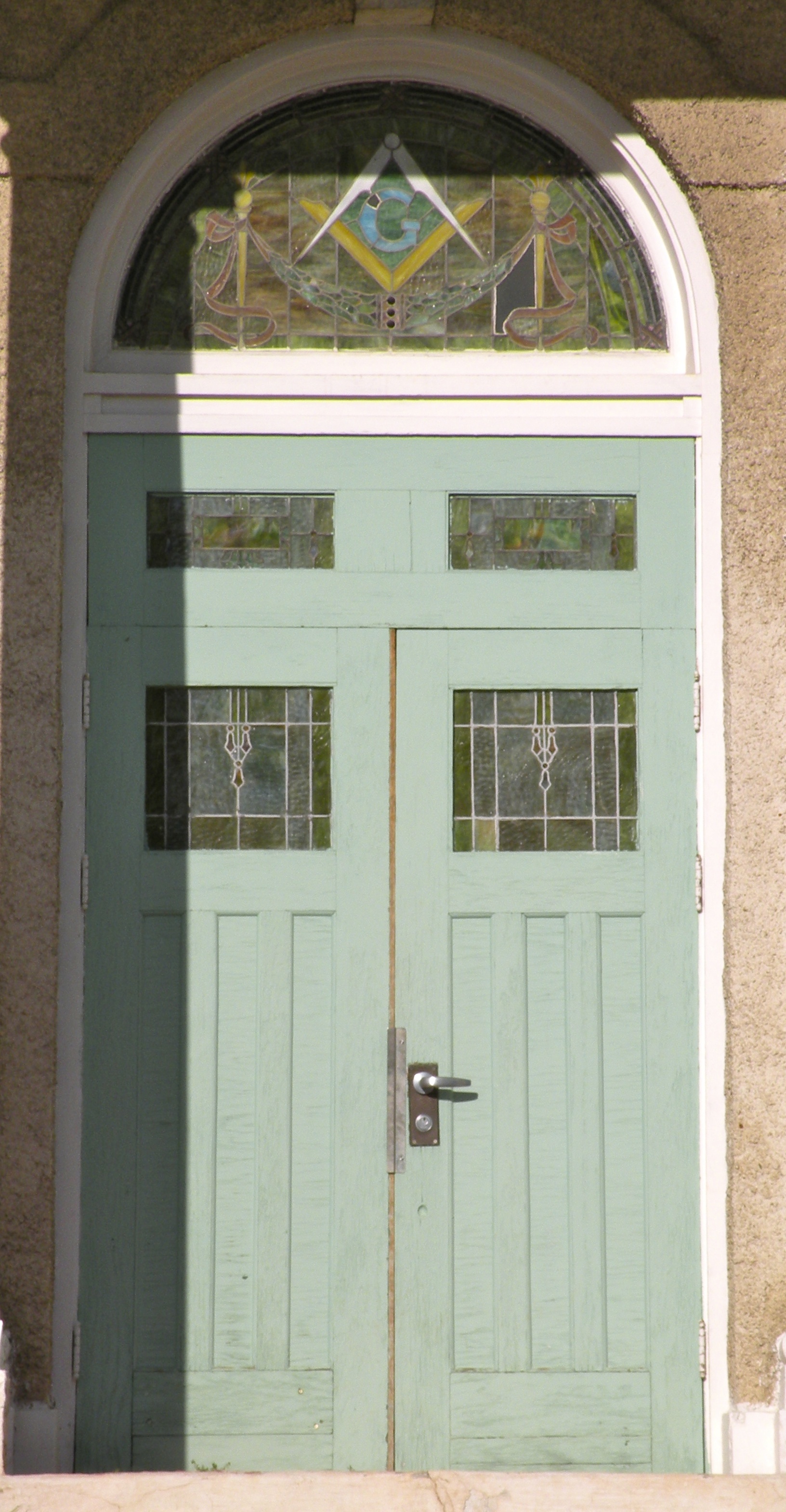
Front Door Temple

The building has a three-bay front with a monumental central entrance flanked by small ornamental leaded glass windows and 1/1 wooden double hung windows with ornamental leaded glass.

The entrance has concrete steps with flanking brick piers. These lead up to the paired ornamental wooden entrance doors with leaded glass glazed panels. The pediment entrance portico on four columns features the name MASONIC TEMPLE set in metal letters in the frieze. 

The north and south facades have a central recessed panel with paired flat columns flanking small windows. The basement has small hatch windows.

Generally, the building has good architectural integrity except for the modern corrugated metal gable roof that was added on top of the original flat roof. The original roof was sealed with half lap asphalt. The newer metal shed roof prevents problems of standing water, periodic leaks, and is almost maintenance free. The walls are hollow red clay tile made by the Seneca Shale Brick Works Co. 

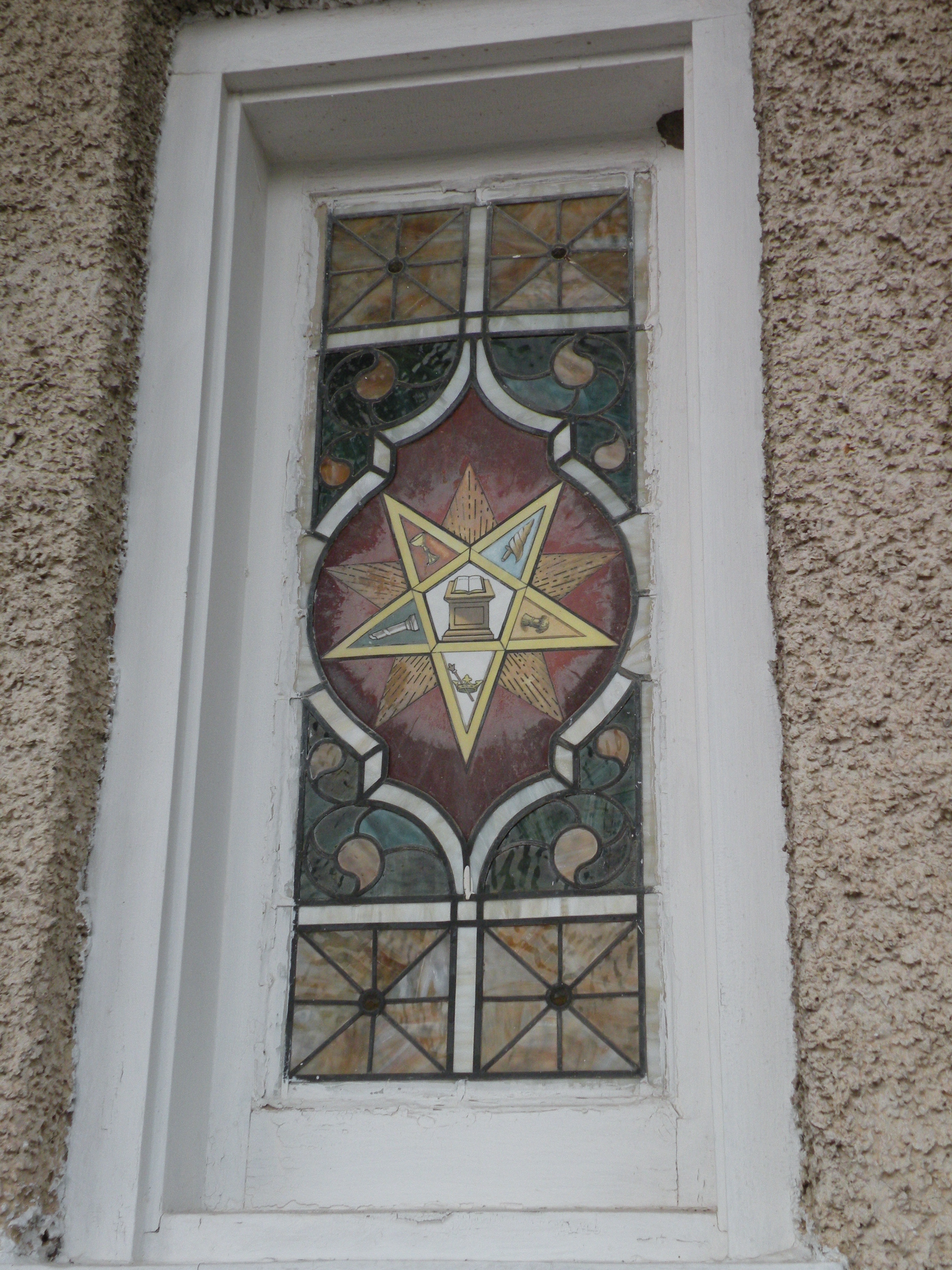
South entrance window

The Seneca Masonic Temple, Seneca, Kansas, was constructed in 1917 and dedicated January 1, 1918. The massive stained leaded glass windows high up in the temple walls are covered with plexus-glass to protect from hail damage, but retain their elegant hues. The outside entrances to the basement on the north and south of the Temple have been covered for security and to prevent snow and moisture build up; an inside stairway leads to the basement from the main level and from the main floor to a second smaller level and up to an even smaller third level where the original Masonic uniform lockers are located. The second and third levels are storage decks and are not public areas. 

The builder of the Masonic Temple was George A.Ahaul of Shaul & Assenmacher who had a staunch and respected reputation in Kansas and Nebraska. He is believed to be one of the most extensive contractors in Seneca’s history. He is credited with building the Masonic Temple, City Hall, the Ely hardware building and Dr.Thomson’s office building in Seneca. He was also instrumental in the organization and management of the Seneca Shale Brick Company which was turning out 20,000 bricks per day in 1916. Mr.Shaul provided labor for a large number of Seneca workmen and was a committed defender of the area. 

North entrance window

Gifted to the Nemaha County Historical Society in 2011, the Seneca Masonic Temple was renamed “Temple of Honor” and now houses the Nemaha County Military exhibition. The historical artifacts – uniforms, photographs, medals, hats, helmets, and flags – represent those who served their country over the last 150 years. All branches of the military are represented. A library of books, maps, letters, and papers are available for researchers. 

The Temple of Honor is open by appointment.

Displayed on the front lawn: 

Tuesday, September 20, 2016

1864 Ordnance Rifle Cannon


The wrought iron 3 inch Ordnance Rifle cannon was invented by John Griffen in 1854 as an answer to the danger of cast iron gun tubes exploding when fired.

The 1864 Ordnance rifle that is on display was presented to Earl W. Taylor American Legion Post 21 but remains the property of the United States Government.

Thursday, September 15, 2016

How Do You Move a Howitzer

A howitzer is a type of artillery piece characterized by a relatively short barrel and the use of comparatively small propellant charges to propel projectiles at relatively high trajectories, with a steep angle of descent.

This one is an armored self-propelled 105 Howitzer M7 Priest. It had a crew of seven and most likely served in WWII and Korea. GI’s commonly referred to this weapon as a Priest due to the pulpit-like shape of the machine gun ring.

The Earl W. Taylor American Legion Post 21 holds a “deed of donation” by the United States for the Priest which calls out a duty to display and maintain for educational purposes. The Legion and Historical Society have signed a joint agreement for the purpose of displaying the Howitzer on the lawn of the Temple of Honor museum grounds. 

How do you move one that is not operational and weighs approximately 25 tons? With a very skilled truck driver, heavy equipment, a heavy chain, and of course volunteers. 

Decide where to park it


Back it into position


Shove it off the trailer
Start it rolling off of the trailer


Pull it into position
Use the tractor to stop it from rolling into the street


Weld the track to the drive so that it will not move


Image 1
And make a final adjustment


Standing Proud
Standing Proud


Meet a Howitzer face to face.

Kansas State Interdisciplinary Team Assists Society


DSCN4337

Working as a team with faculty advisers and members of the Nemaha County Historical Society, students had an opportunity to produce preliminary designs along with some recommended  priorities and estimates, with the idea that the package would provide good technical background for future grant requests and/or a tool  for professional local/regional designers and builders to go to the next level of plan development. It is recommended that full design documents be prepared by licensed engineers and architects and any construction proposals be prepared by qualified contractors.

Interdisciplinary team completes preservation-based undergraduate research project

Tuesday, September 13, 2016

Plaques Dedicated


priestx

ordance rifle

Harold Mitchell family laid memorial stones with information about the Priest and the Cannon.


mitchell10 mitchell11 mitchell12 mitchell13 mitchell14 mithcell9


Thursday, September 8, 2016

Kelly Family Gathering

 A gathering of Kelly Family members was held September 6 and 7, 2014.


From e-mail sent by Gloria Cathcart to the Nemaha county Historical Society:

“Our Kelly ancestors came from Scotland into the area north of Seneca know as Scotch Valley in 1869 – 145 years ago. Our great great grandmother, Agnes (Gregg) Kelly, her brother James Gregg and his wife, a daughter, grandchildren and many other family relatives were buried in the Scotch Valley Cemetery.

In April of 2013 three of the descendants of Agnes had a gravestone installed as a memorial to her. There was never a gravestone for her prior to this. The stone of her daughter Sarah was also updated and some minor repairs to other stones. We were able to do this even though none of us involved live in Kansas, by working through the Nemaha County and local installer. All of this has motivated the get together this fall. 

The group spent time on September 6th at Scotch Valley Cemetery and locating/visiting the farms  of at least four of the children of Agnes (Gregg) Kelly.

We do have a copy of the booklet Scotch Valley 1857-1970 compiled by Mabel Ord and others. This has been a help to us. Some of us have visited Seneca area, others have never been. Family came from California, Oregon, Washington, Missouri, and Kansas as well as others that left Kansas in the very early years of the 1900s and came to Alberta.

We are not connected with the town of Kelly.”

Gloria Cathcart
Edmonton, Alberta, Canada

Tuesday, September 6, 2016

Woman WHo Hid Dead Mother 2.5 Years


Taken from the July 20, 1937  Topeka Daily Capital

Mrs. Myrtle Lattimer of Seneca, who secreted the body of her mother in her home two and one-half years while she continued to cash her mother’s pension checks, was brought to Topeka yesterday by a deputy United States Marshal from Nebraska to face a charge of violating her parole.

She recently was arrested near Falls City, Neb., in connection with a scheme of collecting money for the sale of silk hosiery without delivering the hose. When it was learned she had received a five-years suspended sentence on an old charge of defrauding the government by cashing her dead mother’s pension checks she was brought to Topeka. She had served two years in the government women’s prison at Anderson, W. Va., on another count.

When Mrs Lattimer was arrested in July 1934, the dismembered body of her mother was found in a shed at the rear of her home. She admitted her mother, Mrs.Marietta Bishop, had been dead two and one-half years and she had been receiving and cashing her mother’s $40 pension checks.

At first she experienced no trouble in cashing the checks. Then one bank suspected the mother was no longer living. It refused to cash any more checks. Mrs. Lattimer solved the problem by cashing them at another bank.

A new postmaster, W. L. Kauffman, refused to deliver the pension letter until he was assured Mrs. Bishop was living. A postal clerk asked to see Mrs. Bishop. Mrs. Lattimer informed him the mother was taking a bath. The clerk replied the check would be delivered if a woman he had brought with him could see Mrs. Bishop. Again Mrs. Lattimer refused.

The sheriff was called but could not even find Mrs. Lattimer. She returned a day later, however and was placed under arrest. 

Mrs. Lattimer said her 90 year-old mother, a Civil War veteran’s widow had died a natural death and that she left the body in the bed about six months, then started to dismember it and burn it because the mother had asked that her body be cremated. This method of disposal not being successful, she put the remains in a trunk and put the trunk in the shed. There officers found it.

Mrs. Lattimer, who gave her age as 73, had to be helped to the women’s ward on the second floor of the city jail.

Supplied by Research Staff of B.C.G.S.